
What Happens to Your Parcel at a Sorting Hub
9 September 2026 · 2 min read · by Courier Uncle team · Seeded
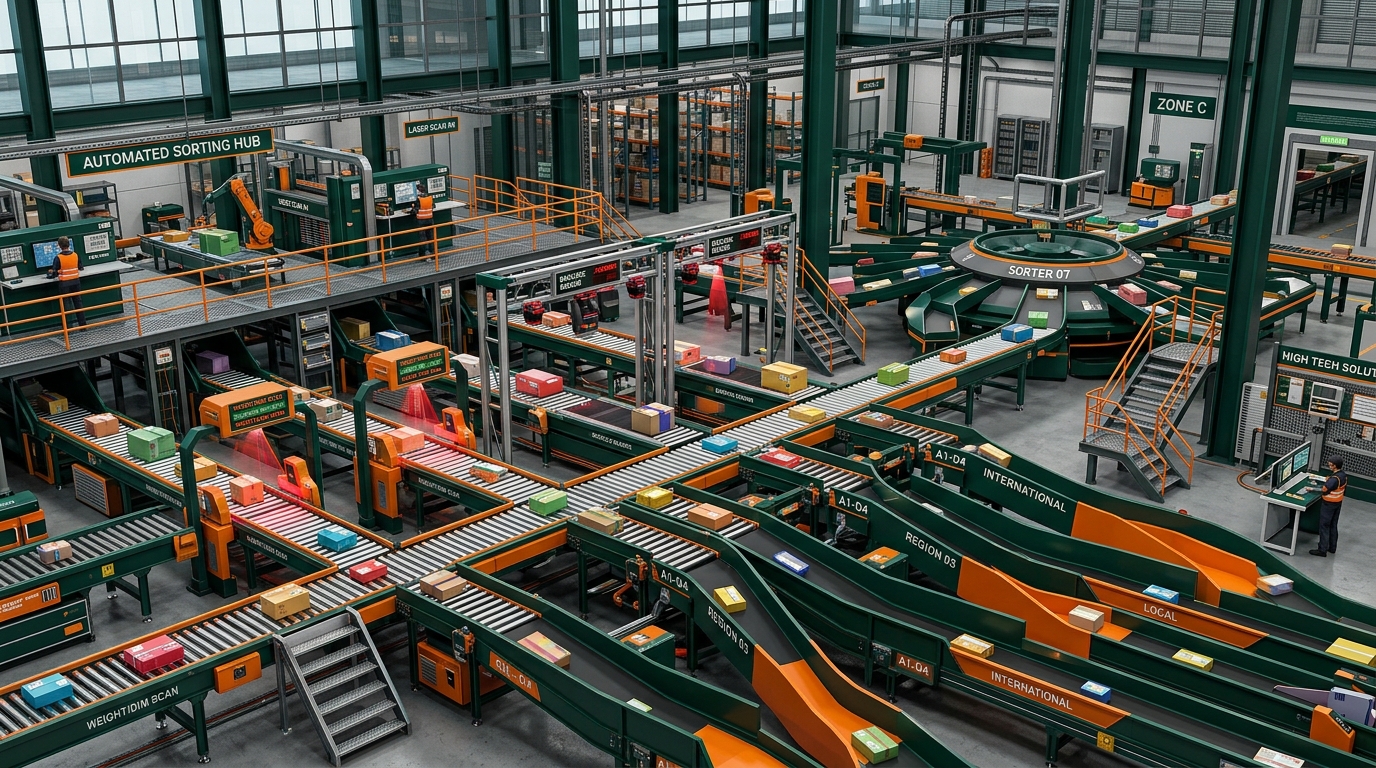
Most billing surprises originate in a fifteen-second window inside a sorting hub. Knowing what happens there explains almost all of them.
The fifteen seconds
Your parcel lands on a conveyor. In one pass it is:
- Scanned — the AWB barcode is read and the parcel is matched to your booking.
- Weighed — an in-line scale records dead weight, typically to 10 g.
- Dimensioned — a volume scanner reads the bounding box, usually to the nearest half or whole centimetre.
- Compared — measured chargeable weight against declared.
- Routed — to the right onward bag or vehicle.
If step 4 disagrees with your declaration beyond a tolerance, a discrepancy is raised automatically. No human looked at your parcel.
What this tells you
The scanner measures the bounding box. A bulge in a poly mailer, a corner of tape sticking out, a parcel that will not lie flat — all of it counts. This is why declared dimensions should be measured at the widest point and rounded up.
It measures a rectangle around an irregular parcel. A cylindrical or awkwardly shaped item is dimensioned as the box that would contain it, which is larger than the item.
Automation has failure modes. Two parcels touching on the belt can be read as one. A label that scans poorly can attach a reading to the wrong AWB. Units get misconfigured — a reading of 5,987 “kg” is a grams value in a kilogram field. These are the discrepancies worth contesting, and they are why evidence at dispatch matters.
Tolerance is a real thing. Most carriers do not raise a discrepancy for a few grams. If you are getting notices on tiny differences, that is worth raising with your account manager.
Practical takeaways
- Tape parcels flat; no protrusions.
- Do not let labels wrap around an edge — a poor scan is a misread waiting to happen.
- Use rigid enough packaging that the parcel keeps its shape on a belt.
- Declare the bounding box, because that is what will be measured.
Frequently asked questions
How accurate are hub scales?
Generally accurate to about 10 g and calibrated on a schedule. Accurate does not mean infallible — misreads happen, which is why contesting with evidence works.
Can I ask for the scan data?
Yes. Carriers can usually produce the recorded weight, dimensions and often a timestamp for a specific AWB. It is a reasonable thing to request when you are disputing.
Why did my parcel get measured differently on two shipments?
Different hubs, different scanners, different packing on the day. Consistent packing produces consistent measurements.
Ship smarter with Courier Uncle
Compare live rates across multiple couriers on your actual routes — sign-up is free, no volume commitment.
Compare rates free →